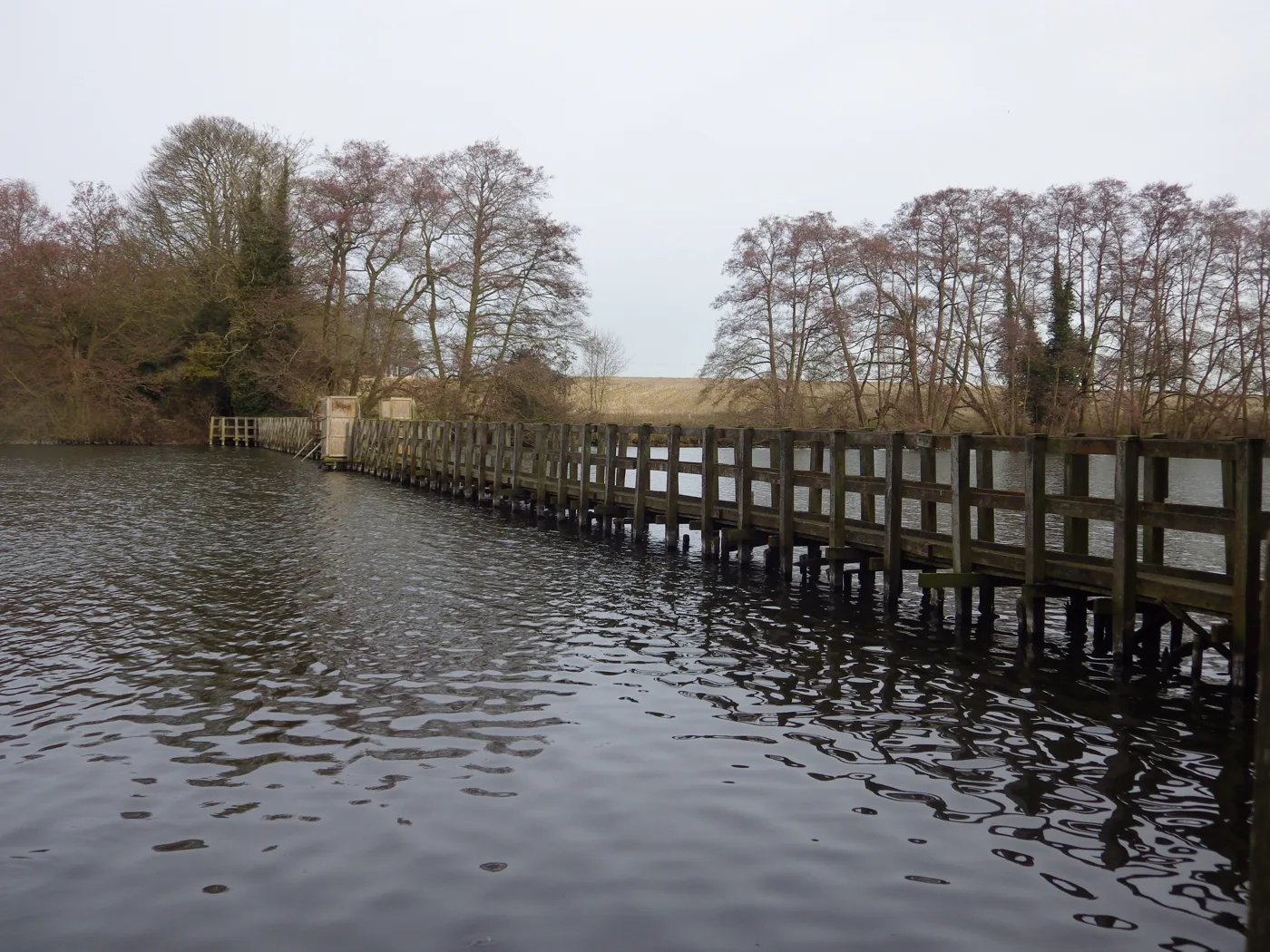

Every consultee backs or does not object to replacing the Ampton Water footbridge, shut since 2022. Comments closed 22 Oct; the county's decision is next.
The long timber footbridge across Ampton Water, closed to walkers since early 2022, is to be demolished and replaced if Suffolk County Council approves its own planning application. Comments on the scheme closed on Thursday 22 October (application SCC/0144/26SE).
Updated 24 October: the consultation has closed with no objection from any consultee, and Great Livermere Parish Council supports the scheme. The application is now pending a decision. What each consultee said.
Ampton Water is the lake between Ampton and Great Livermere, about five miles north of Bury St Edmunds. The bridge carries two public footpaths, Great Livermere footpath 13 and Little Livermere footpath 3, which meet at the parish boundary in the middle of the water. Both have been shut under a temporary closure order because the structure is “considered unsafe for use and at the end of its life”.
What is proposed
The council’s design and access statement describes the old bridge as a roughly 70-metre raised timber causeway with posts and parapets. Over the years it gained a raised central section built on a scaffolding frame, and timber shooting platforms hung off its side (design and access statement).
Rather than rebuild it, the council wants to:
- take the old bridge down
- move the crossing about 15 metres east, onto an existing hardcore causeway that already runs most of the way across the lake
- bridge the one 15-metre gap in that causeway with a modular steel and timber footbridge of the “ranger-style” type used on rural paths across the country
- divert the two footpaths by legal order so they follow the new line
The new bridge would have approach gradients no steeper than 1 in 20, an anti-slip deck and a timber parapet. The council says removing the old stepped and raised section is “a significant accessibility improvement”. The site is 0.15 hectares of land owned by Ampton Hall Estates, which also owns the lake.
Why not just repair it
The council looked at five options. Four were rejected:
- replacing the whole structure
- replacing the raised section like for like and repairing the rest of the deck
- replacing the raised section with boardwalk and repairing the rest
- removing the raised span, filling the gap to make an island, and repairing the rest
The statement says those were discounted for “significant environmental disturbance”, “high cost and poor sustainability”, “engineering impracticalities” and reduced accessibility. The causeway option was “the least intrusive, most sustainable, and most accessible solution”.
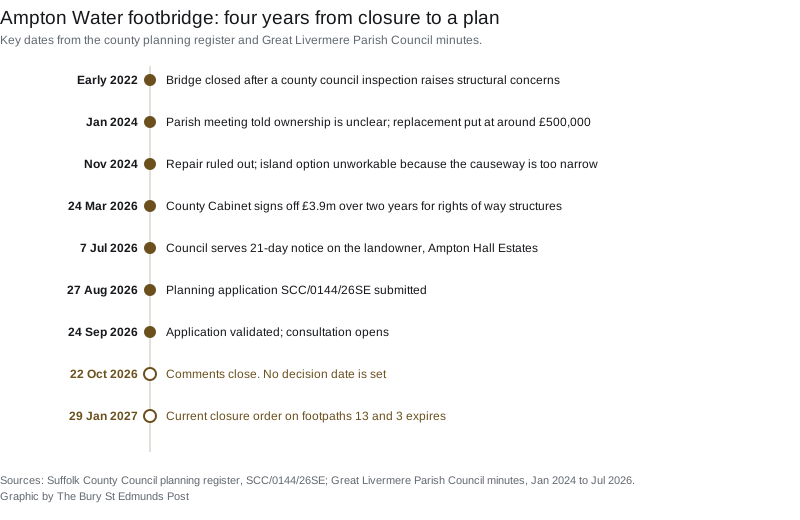
Great Livermere Parish Council’s minutes fill in the history. In January 2024 the council’s rights of way manager told a parish meeting attended by residents that the bridge had been closed for two years after an inspection raised concerns about its structural integrity, that it was unclear who owned it, and that a replacement could cost “in the region of £500,000” (parish minutes, January 2024).
By November 2024 repairing it had been ruled out. Building islands instead was “unworkable”, because the causeway was too narrow to carry the excavator needed (parish minutes, November 2024).
Who is paying
The money comes from a county budget line agreed this year. The parish council was told in May that Suffolk County Council’s budget in January, signed off by its Cabinet on 24 March, provides £3.9 million over two years for public rights of way structures. Of that, £2.6 million is for “significant structures”, and Great Livermere is on the list (parish minutes, May 2026).
The same update hoped the work would be done in “early September”. That has slipped. The council served notice on the estate on 7 July, submitted the application on 27 August, and the county’s planners validated it on 24 September (parish minutes, July 2026).
What the consultees say
Every response on the register either supports the scheme or does not object. The register shows the application as “Pending a Decision”.
- Great Livermere Parish Council supports it. Its comment, received on 22 October, reads: “The Parish council support this application” (comment).
- The county councillor for Brandon, Tim Kent, supports it (response).
- West Suffolk Council has no objection, “subject to SCC being satisfied as to the suitability of the wider effects” (letter of 14 October, its reference DC/26/1526/CR3) (response).
- Natural England has no objection. It says the bridge will not have “significant adverse impacts” on protected sites, and points the county to standing advice on ancient woodland (response).
- The county’s rights of way team does not object. It reminds the applicant that planning permission does not itself close or divert a footpath; that is a separate legal process (response).
- The county’s archaeology service sees “no significant impact” and asks for no mitigation (response).
- The county’s flood team recommends approval (response).
- The county as highway authority does not wish to restrict permission (response).
- The county’s ecology team had no objection earlier in the month. It flagged giant hogweed on the works site and asked for any clearance to happen between September and February, to avoid nesting birds. Because the footprint is so small, the scheme is exempt from the usual biodiversity net gain requirement (SCC Ecology response).
The lake is a County Wildlife Site, designated for its birds, with ancient woodland next to the working area. The site is in flood zones 2 and 3, and the Ampton and Great Livermere conservation areas are 350 metres and 900 metres away. The council says it consulted the Ramblers, the parish councils and the landowner before applying, and that all wanted “a suitable pedestrian route in a timely fashion”.
What it means for you
- The paths stay shut for now. The closure order on Great Livermere footpath 13 and Little Livermere footpath 3 runs until 29 January 2027, and the council says the footpaths will stay closed until the new bridge and the legal diversion are complete. Our roadworks and travel page tracks the order.
- The comment period has closed. It ended on 22 October. The register page will show the decision when it is made.
- The decision is the county council’s own. Because the applicant is the county’s rights of way team and the decision-maker is the county’s planning team, this does not go to West Suffolk Council. No decision date is set.
- The old bridge goes. If approved, the demolition and the new crossing are one scheme. The diversion order for the footpaths is a separate legal step, on which the parish councils are consultees.
Have your say